 Journey with Junyuan
JapanAsia
From Nagano, I continued west to Kanazawa — an easy 90-minute ride on the Hokuriku Shinkansen that carried me through the Japanese Alps and out toward the coast of the Sea of Japan.
Kanazawa feels different from Japan’s bigger cities. Often kicknamed as 'Little Kyoto', it’s compact, cultured, elegant, and free from crowds. Though I thought it was unique in its own way with its exquisite gardens, preserved geisha and samurai districts, and a long tradition of arts and crafts. I stayed for 2 nights in Kanazawa, which felt like the perfect amount of time to experience the city at a slower, more unhurried pace.
Kanazawa is well connected by the Hokuriku Shinkansen.
Kanazawa Station itself is impressive — don’t miss the dramatic wooden Tsuzumi Gate at the east exit before heading into the city. Kanazawa is pretty compact and mostly walkable, though local buses make longer hops easy. Some tourists also like to rent an e-bike to get around.
I stayed at Tokyu Stay Kanazawa, just west of the castle complex. It ended up being one of the most affordable stays of my Japan trip, yet one of the best in terms of comfort and quality. My room was very spacious by compared to most Japanese hotels, and the in-room washer-dryer was such a bonus mid-journey! 🫧
The area around Kanazawa Castle and Korinbo is especially convenient — close to gardens, museums, restaurants, and shopping streets. You can reach most major sights on foot from here.
~~~

Kenroku-en Garden


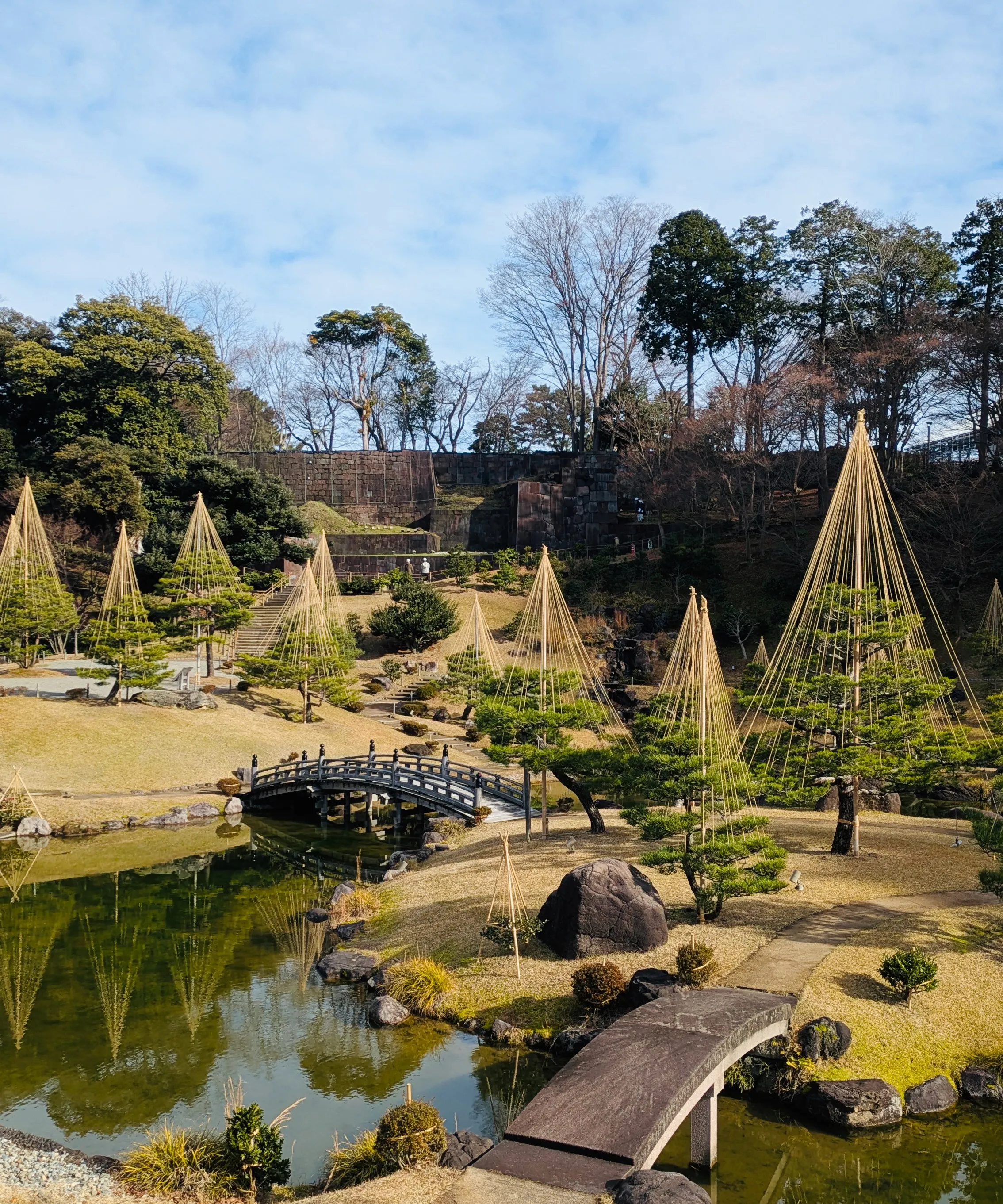
Kenroku-en Garden is considered one of Japan’s three most beautiful landscape gardens — and it genuinely lives up to the reputation. Carefully designed ponds, stone lanterns, winding paths, and seasonal plantings create a setting that feels both curated and natural. In winter, snow-dusted trees and protective yukitsuri ropes add a quietly magical atmosphere. In autumn, fiery koyo take over.
Kenroku-en Garden has a small admission fee of 320 yen, but it also has a free admission period between 7-8am for the early birds who want to avoid the crowds. The access for free admission is only via Mayumizaka Gate or Katsurazaka Gate.
The street right outside Kenroku-en, on the side of Mayumizaka Gate and Renchi-mon Gate, also has lots of lovely tea and gift shops. After exploring the garden, I had a much-needed matcha break and roasted some dango, which was such a cute and wholesome activity! 🍡
Right next door, Kanazawa Castle Park offers wide walking paths, restored gates, and open views that balance the intimacy of the garden. Also worth stepping into is Gyokusen-inmaru Garden, a smaller but equally beautifully arranged space at the base of the castle.
I spent half a day in this entire area, but I could easily spend a whole day here!
~~~

Higashi Chaya District


Kanazawa is famous for preserving its historical neighbourhoods — and they’re wonderfully atmospheric to explore.
Kanazawa is particularly known for:
You’ll find small workshops and galleries tucked between historic buildings — and yes, you absolutely should try the gold leaf soft serve! 🍦 If you’re feeling creative, you can even join a gold leaf workshop.
Kanazawa's craft culture runs deeper than most visitors get to see on a short trip. If you want to go beyond wandering and actually sit with the people behind it — whether that's a sake brewer, a tea master, or a bonsai artisan — Wabunka curates private, premium stays and experiences across the city's historical districts that are hard to find elsewhere. Worth exploring if Kanazawa's quieter, artisanal side is what drew you here in the first place. Explore Kanazawa experiences on Wabunka →
~~~

Ozaki Shrine by Kanazawa Castle Park


Beyond the main attractions, Kanazawa has a surprisingly large number of serene temples scattered across the city.
The Teramachi Temple District is perfect for a quiet wander, with clusters of historic temples away from the main tourist routes. Mount Utatsu, just behind Higashi Chaya, offers gentle walking trails and panoramic views over the city. These quieter areas had little to no tourist when I visited.
~~~

Running path along Sai River


If you are like me and enjoy some 'run-seeing', Kanazawa’s has some wonderful riverside paths, where you'd see many locals walk, run, or cycle.
The Asano River, near Higashi Chaya, feels intimate and historic, especially at sunset. The Sai River offers wider paths and open skies. Both provide peaceful breaks from sightseeing and lovely mountain-backed views — particularly beautiful in the golden evening light.
If you're only stopping in Kanazawa without going to Takayama, you might want to consider a day trip to Shirakawa-go, a UNESCO World Heritage Site famous for its traditional gassho-zukuri farmhouses. Both Highway Bus and Nohi Bus have services on the Kanazawa—Shirakawa-go-Takayama route. It takes about 1 hour 25 mins between Kanazawa and Shirakawa-go. It's an extremely popular destination so pre-booking is highly recommended as the line for non-reserved seats gets very long! 😬
I have a more detailed guide on Shirakawa-go here.
Kanazawa punches well above its weight when it comes to museums.
You don’t need to visit them all — but choosing one or two adds a thoughtful cultural layer to your stay.
Known as “Kanazawa’s Kitchen,” Omicho Market is the place to sample fresh seafood from the Sea of Japan. Expect fresh sashimi and sushi, seasonal crab (especially in winter), local produce and street snacks. It’s lively, colourful, and perfect for a casual lunch between sightseeing stops.
~~~
Kanazawa offers a beautifully balanced 2-day escape — elegant gardens, preserved wooden streets, refined crafts, and fresh coastal cuisine, all within walking distance.
It feels cultured without being overwhelming, historic without being frozen in time. After the mountains of Nagano, Kanazawa’s coastal calm and artistic heritage make for a seamless and enriching next stop on a central Japan itinerary.
👉 Explore the complete 2-week Japan itinerary here
~~~~~~